


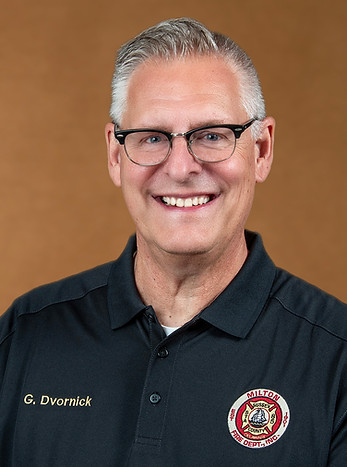
About Gene Dvornick
With more than 40 years of experience in local government, public safety, financial management, and community leadership, Gene has built a career dedicated to serving Sussex County. Known for his integrity, fiscal responsibility, and commitment to public service, he has focused on solving problems, protecting taxpayers, and strengthening the communities he serves.
Gene believes public service is about making a positive difference in people's lives. His leadership is guided by five core values: Commitment, Integrity, Honesty, Dedication and Experience. Whether managing a town, leading first responders, or volunteering in the community, he has consistently focused on listening, building consensus, and delivering results.
As the moderate Republican candidate for Delaware House District 20, Gene is committed to supporting first responders, promoting responsible growth, strengthening the local economy, and ensuring government remains accountable to the people it serves.
Experience & Accomplishments
-
Town Manager, Georgetown (2007–Present) – Leading municipal operations, budgeting, infrastructure planning, and community growth.
-
Delaware Town Manager of the Year – Honored twice, in 2009 and 2024, for outstanding leadership.
-
Former Milton Town Council Member (2004–2007) – Bringing both elected and administrative experience to public service.
-
Volunteer Firefighter & Fire Chief – More than 40 years of service, beginning as an EMT in 1985 and serving in numerous leadership roles.
-
Financial Professional – Master of Accountancy from Virginia Tech and Master of Public Administration from the University of Delaware, providing the expertise to manage budgets responsibly and protect taxpayer dollars.
-
Dedicated Community Volunteer – Longtime mentor with Big Brothers Big Sisters of Delaware and Guiding Eyes for the Blind, and board member for organizations including the Rehoboth Beach Film Society, First State Community Action Agency, CAMP Rehoboth and La Plaza Delaware.
-
State and Local Governmental Memberships – Delaware League of Local Governments and Sussex County Association of Towns, and Son of the American Legion.
OUR MISSION
Gene Dvornick's priorities for District 20
What are the most important challenges facing our state, and how do you the propose to address them?
The most pressing concerns facing Delaware families are one-party rule and diminishing revenue streams. These two issues require practical, common-sense solutions and bipartisan cooperation. These two concerns are also directly tied to other statewide issues such as housing affordability, workforce development, emergency services, land protection and small business growth.
In the 20th District, infrastructure is unable to keep pace with rapid growth in population and housing. Infrastructure includes safe transportation, modern water, sewer, and stormwater management systems. As one of the fastest growing areas in the State, this district generates significant realty transfer tax revenue. Currently, the same amount that goes out from RD 20 is not fairly returned to it. But what’s returned is needed to pay for critical infrastructure reinvestment. New development pays the upfront cost to install project infrastructure, but local jurisdictions also need to improve and maintain existing infrastructure. As existing infrastructure ages, the need for reliable, dedicated revenue streams to maintain it becomes increasingly necessary. These two components are not mutually exclusive. Ultimately, there needs to be a much better balance between the revenues generated locally and the funding returned for sustainable reinvestment. I would return this balance in Dover.
First, political balance is what the state needs. One-party rule does not help Delawareans in our towns, counties and state. A healthy democracy works best when no single party has unchecked power. Both parties must have a meaningful voice in Dover. We need policies that appeal to the political center and not just those who sit on the edges of political parties. Moderation is key, which is why this balance is necessary. It is no coincidence that I am running a moderate Republican because I have worked with both parties to form successful partnerships and projects. When one party controls the Governor's office, the House, and the Senate with a supermajority, there are fewer incentives to question ways of doing things, challenge proposals, or improve legislation. Some might say balance creates a standstill, but I believe balance promotes accountability. This is why the framers of the Delaware Constitution specifically outlined an amendment process requiring passage in two separate, consecutive general assemblies separated by a General Election. This prevents changes being made on the whim of one party. I don’t seek partisan confrontation. I seek bipartisan problem-solving. That is why I’m running for state representative.
Second, Delaware faces limited revenue streams and changes to these streams over time. It used to be that these revenue streams came from the automobile industry (Chrysler, GM) banking (MBNA), chemicals (Dupont), agriculture (farming and poultry) and tourism. Over time several of these have disappeared. Personal income tax revenue remains the state’s number one revenue provider, but our reliance on this source has increased resulting in recent changes to tax brackets. For new and lifelong residents, we must manage our growth and revenue sources simultaneously and carefully. The challenge is that personal income tax revenue decreases as economic downturns occur. In Delaware, there is no one-size-fits all approach and has many nuanced applications and decisions. As other states pursue attracting businesses from Delaware, we will see a direct reduction of the franchise fees. When businesses leave to go to Arizona or Texas, there is a direct impact to the residents of Delaware. There are limited options to recover this loss of revenue. Over time, the state has seen a reduction in the diversified revenue streams to a finite set of revenue sources. In Dover, I would look for opportunities to reduce costs, improve efficiencies and, as a last resort, explore opportunities to increase revenues through other sources.
###
Homelessness in Delaware more than doubled in 2022. What legislation would you propose to reduce the number of unhoused in Delaware?
Since 2007, I have witnessed people who have been chronically homeless in Georgetown. Several are known on a first name basis by service agencies, town staff and the police department. Why is this? This can have many reasons, including mental health issues, drug addiction and lack of services. It could be any one or a combination of these factors. No two people are unhoused for the exact same reason. Each one is unique, and issues including chronic homeless, lack of services for mental health and addiction and lack of housing contribute to the ongoing problem. This is a complicated issue with no one-size fits all solution. We’re not going to legislate our way out of it.
I don’t want to see people standing in downtown doorways or at intersections begging. It’s a safety risk and a nuisance; however, these people, as unsightly as they may seem, should still be treated with dignity. Let me tell you that we can’t just simply ignore unhoused people. The problem will not go away even though it may make people uncomfortable. While I believe nobody wants to be unhoused, the solution is not endless handouts with no accountability. Empower, don’t enable.
To understand homelessness and how to house them, we must understand its causes and that it will take a comprehensive approach to solve it. That is what my proposed legislation would underscore. Again, to reduce the number of unhoused in Delaware, legislation, in any form proposed by any legislator must include a community-wide, strategic approach. At the same time, there must be consequences for not following the guidelines to solve homelessness.
Below are legislative solutions that must combined, and I’m not sure in what order.
First, we must increase shelter beds. Another component of this is the ability to track individuals so that you know what services folks are receiving because these same individuals are receiving duplicated services and this is an ineffective use of resources. The same people may be receiving the same services at four different locations. We need to have an accurate census of the unhoused because doing the one-time, point-in-time count may not accurately reflect the magnitude of the unhoused population. (e.g. counting in the wintertime may be artificially low compared to counting in the summertime). Another significant component of this legislation must include services and support to the chronically unhoused (e.g., substance abuse, alcohol abuse, mental health issues, etc.).
The most significant piece of the puzzle must also include a coordinated effort among service providers and meaningful metrics. We can help people move from homelessness to stability by connecting them with workforce training in fields like healthcare, hospitality, construction, and skilled trades, while also providing the support services needed to succeed on the job (e.g, paid on-the-job training, work clothes, transportation, etc.) Let’s create an expectation to help unhoused people be better and contribute to our community, not be alienated from it. It has been demonstrated in other states that unhoused people who are afforded opportunities to better their lives are responsible for making choices for success or failure. This puts the responsibility back on the individual to show up for work on time, be ready to work, earn a wage and increase their quality of life. If they don’t this, it is their own choice.
Government cannot solve the unhoused problem. We can reduce homelessness by addressing root causes, expanding treatment options, strengthening public safety, and helping people return to work and stable housing. Compassion and accountability must go hand in hand.
###
What, if anything, should our state do over the long term to ensure quality healthcare at an affordable cost for all?
Providing sustainable, affordable, quality healthcare for all is not a partisan issue.
Why should anyone have to wait a year or more for a standard check-up or follow-up doctor visits? We need to assure residents have more access to healthcare, so that families can afford prescriptions, and that seniors live better-quality lives than merely subsisting on supplemental insurance to Medicare. As we are growing, we are also aging. State officials at Health and Human Services just declared that health care spending is uncontrollable and unsustainable.
The first solution is to persuade people from going to our emergency rooms for daily healthcare needs or minor accidents and illnesses. What happens is for people who don’t have or can’t afford healthcare, they go to the emergency room. We need to discontinue emergency room use as people’s primary care provider. After many years of responding to EMS calls, I have taken countless people to the emergency room for issues that could have been addressed sooner in a doctor’s office at a lower cost. These proposals will reduce emergency room visits and lower costs. Our district is facing unsurpassed growth. To achieve this, we need early interventions, appropriate diagnoses and relevant, long-term treatment not emergency room visits for such health challenges. It’s proven that if people take care of themselves and stay healthy, health costs go down.
Next, is to take healthcare services to where the people are. Let’s increase mobile health vans, especially to our district’s rural areas. In doing this, we would also increase healthcare access to the disadvantaged. By reaching all these people, we will reduce everyone’s overall costs. Next, we need baseline monitoring of those who need and seek healthcare so we can have a starting point to know what we need to do. If we have this baseline, we can monitor areas of acute healthcare needs in terms of kinds of diseases and the geographical areas from which they come. This would help solve the healthcare access problem.
Finally, it’s no secret that we have a shortage of doctors, nurses and other health care providers. We need to address affordable housing for these people. My doctor’s office receptionist used to live in this area. We’ve gotten to know each other over the years. She must drive from Seaford – more than 45 minutes, if not more, just to get to work. This is why providing affordable housing is so important. In another instance, when I was knocking on doors, a retired Beebe nurse told me she used to live within Lewes City limits. She had to move in with her daughter outside of Lewes just to keep working there despite years of providing care for area residents. This is ridiculous.
To sum up, we need to establish a healthcare campus for higher education in Sussex County, so students don’t have to leave the area to pursue this type of education. Next, for students to remain in the area after they graduate, institutions should provide fellowships for doctors who stay in the area. Train here, stay here. Medical partnerships could support these healthcare campuses and scholarships.
###
Fiscal Responsibility
Taxpayers deserve a government that spends wisely and lives within its means. Drawing on decades of financial management experience and a Master of Accountancy, Gene will advocate for responsible budgeting, transparency, and eliminating waste while protecting essential public services.
Smart Growth & Infrastructure
Sussex County continues to grow rapidly. Gene believes growth should be planned responsibly, balancing economic opportunity with investments in roads, utilities, public safety, and infrastructure while preserving the quality of life that makes our communities special.
Strong Public Safety
After more than 40 years in the volunteer fire service, Gene understands the importance of supporting firefighters, EMS professionals, law enforcement, and emergency management personnel. He will work to ensure first responders have the resources, training, and equipment needed to keep our communities safe.
Local Government Solutions
Having served as both a Town Manager and elected Town Council member, Gene knows that the best solutions often begin at the local level. He will advocate for policies that respect local decision-making and provide municipalities with the tools they need to serve residents effectively.
Economic Opportunity
Small businesses are the backbone of Sussex County's economy. Gene supports policies that encourage entrepreneurship, reduce unnecessary regulatory burdens, attract investment, and create quality jobs while maintaining fiscal responsibility.
Government Accountability
Gene believes public office is a public trust. He is committed to honest, transparent leadership, listening to constituents, and making decisions based on what is best for the people of District 20, not politics.
Community First
Throughout his career, Gene has focused on serving others. Whether mentoring youth, volunteering in the fire service, or leading nonprofit organizations, he believes strong communities are built through service, collaboration, and respect for every individual.
Practical Leadership
Gene isn't running to make headlines – he's running to solve problems. He brings decades of real-world experience managing budgets, leading teams, responding to emergencies, and delivering results. His approach is simple: listen, work hard, build consensus, and put the interests of Sussex County families first.
